
What Life in Gaza Looks Like This Week

The diplomatic headlines this week are familiar. Trump’s Board of Peace met in Washington with $17 billion in pledges and one Palestinian in the room. Netanyahu threatened to resume the war if Hamas does not disarm within 60 days. Nineteen countries signed a joint statement condemning Israel’s de facto annexation of the West Bank. These are important developments, and I have written about them elsewhere.
But the stories that reveal the most about what is actually happening in Palestine right now are not the ones leading the news cycle. They are smaller, more specific, and more difficult to look away from. This week, I want to draw your attention to several of them.
The farmers who go to work under gunfire
Mohammed al-Slakhy returned to his family’s farmland in Gaza City’s Zeitoun neighborhood as soon as the ceasefire began last October. He and his family spent months clearing rubble from what remained of their greenhouses, preparing the soil, and planting courgettes. They are farming one hectare. Before the war, the family cultivated 22.
The other 21 hectares lie inside Israel’s expanding buffer zone, which now covers roughly 58 percent of the entire Gaza Strip. Mohammed’s single accessible hectare sits about 200 meters from the “yellow line,” the boundary of that zone. Israeli tanks approach regularly and fire. On February 12, tanks advanced into Salah al-Din Street and opened fire near his location.
On February 6, his neighbor and friend Khaled Baraka was shot and killed by Israeli forces while working his land in eastern Deir el-Balah.
Seventy-five-year-old Eid al-Taaban farms nearby. His land sits 300 meters from the yellow line. He told Al Jazeera: “Every time my sons go to irrigate the crops in the greenhouses, I just pray that they come back alive.” Eid’s grandfather farmed in Beersheba before 1948. The family has been farming in exile ever since.
According to the UN Food and Agriculture Organization, over 80 percent of Gaza’s cropland has been damaged and less than five percent remains available for cultivation. Before the war, Gaza was largely self-sufficient in locally consumed vegetables, eggs, poultry, milk, and fresh fish. That capacity has been destroyed. The farmers returning to what is left of their land are not engaged in a symbolic act. They are trying to rebuild a food system from almost nothing, under fire, with no guarantee they will survive the walk to the greenhouse.
The children who carry sacks instead of schoolbags
In Khan Younis, 15-year-old Mahmoud wakes at 5:30 in the morning in a crowded tent. He does not reach for a schoolbag. He picks up a rough burlap sack and heads into the streets to collect and sell whatever he can find. “The sack is empty now, but I feel its weight even before I fill it,” he said. “My back hurts before I even start walking.”
On al-Bahr Street, 11-year-old Layla walks back and forth selling cups of tea for one shekel. Her father has a physical disability and cannot work. The burden has fallen on her.
Ninety-four percent of Gaza’s schools have been completely destroyed. The schools that still stand are largely occupied by displaced families. Gaza’s GDP has collapsed by 83 percent. Yaqeen Jamal, an educational psychologist working with children during the war, described the situation plainly: rebuilding schools and resuming education “must be the top priority, because education is the last line of defence for people’s identity and future.”
Meanwhile, UNICEF estimates that at least 17,000 children in Gaza are unaccompanied or separated from their families entirely. Over 11,000 children recently participated in a UNICEF initiative called “The Gaza We Want,” where they were asked to draw and describe their vision for the future. Thousands of children, independently, drew the same things: clean streets, classrooms with roofs, parks where they could play. As UNICEF’s communications chief in Palestine put it: “These are not extraordinary demands. They are the fundamentals of childhood.”
Ramadan in the rubble
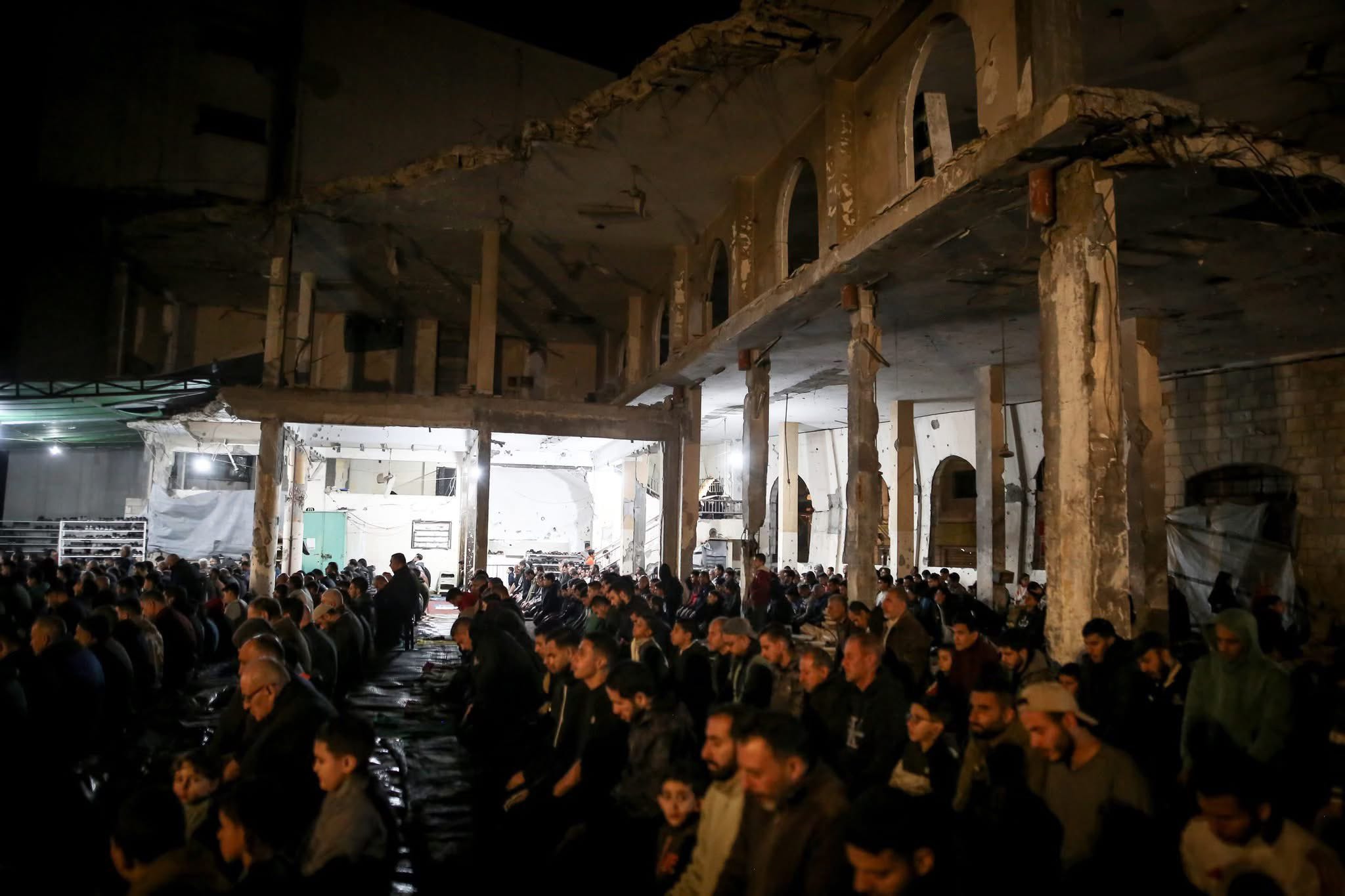
This is the third Ramadan since the war began, the first under the nominal ceasefire. The holiday is almost unrecognizable.
In northern Gaza City, 25-year-old Amjad Joudeh sits in his partially destroyed house. His happiest Ramadan memories are of walking hand in hand with his father and brothers to the mosque for Tarawih prayers. He lost his entire family, parents and four younger siblings, in a single air strike. This year, he goes to the mosque alone.
In the Bureij camp in central Gaza, 52-year-old Maisoon al-Barbarawi hung simple decorations from the ceiling of her tent and bought her nine-year-old son Hasan a small Ramadan lantern. She pointed to bullet holes in the tent’s fabric, left by a quadcopter drone days earlier. “I will pray that the war never returns,” she said. “That is my daily prayer.”
A writer in northern Gaza, published in +972 Magazine this week, described how the holiday once marked by lively streets, plentiful meals, and easy moments with loved ones now takes place “amid streets scarred by bombs and swallowed by darkness.” Over the past year, the writer’s mother, uncle, and grandmother all died from medical conditions that were likely preventable under normal circumstances.
The economics of Ramadan tell their own story. An Al Jazeera analysis found that a basic iftar meal for a family of six now costs about 150 shekels, roughly $48, up 90 percent from pre-war prices. During periods when Israel tightened the siege or closed the crossings entirely, food prices spiked by more than 700 percent. Annual per capita income in Gaza has fallen to $161.
Families who once prepared elaborate meals and visited relatives now organize their fasting days around aid distribution schedules. A Mondoweiss correspondent writing from exile described how the genocide “was not only the physical destruction of Gazans’ bodies and the annihilation of families,” but also “erased memories, traditions, and everything that reminds us of what we were.”
A five-year-old denied a bone marrow transplant
Mohammad Abu Asad is five years old. He was diagnosed with aggressive leukemia while living in Gaza, where the medical infrastructure could not treat him. His family moved to the occupied West Bank to access better care. When his condition deteriorated and he urgently needed a bone marrow transplant, a hospital in Tel Aviv agreed to perform the procedure.
In early February, an Israeli court rejected his petition to enter Israel, citing a blanket ban on the entry of all Palestinians from Gaza, regardless of where they currently reside.
This story did not make major headlines. But it captures, with painful clarity, how the blockade operates: not as an abstraction, not as a policy debate, but as a specific decision to deny a specific child a medical procedure that could save his life. The hospital was willing. The court said no.
Across the occupied territories, movement restrictions have reached their highest levels. At least 898 checkpoints of various types were identified across the West Bank in 2025. Israel has extended military orders restricting movement in and around the Tulkarm, Nur Shams, and Jenin refugee camps, designating them as “closure areas” off-limits to Palestinians without military permits.
What these stories share
The diplomatic summits, the billion-dollar pledges, the ceasefire negotiations: these receive the headlines, and rightly so. But the stories above reveal what those headlines tend to obscure. The ceasefire has not ended the killing. The buffer zone is making agricultural recovery nearly impossible. Children are working instead of learning because the entire education system has been destroyed. Families observe their holiest month in tents with bullet holes. A child with cancer is denied treatment by a court order.
These are not background details. They are the texture of a siege that continues to operate even when the cameras turn to Washington. They are the evidence of what policy language calls a “humanitarian situation” but what is, in fact, the systematic constriction of Palestinian life at every level.
The people in these stories are not waiting for rescue. Farmers are replanting under fire. Mothers are buying lanterns for their children. Teachers and psychologists are trying to rebuild schools from nothing. Children are drawing classrooms and parks. They are doing this because they refuse to let the siege define the limits of their future.
The question is not whether Palestinians will persist. They will. The question is whether those with the power to act, to enforce arms embargoes, to condition military aid, to hold Israel accountable for violating its own ceasefire, will do so before these stories become permanent.