
The War that Shaped Me

Fifteen years ago, I witnessed the first bombing of Israel’s 2008–09 aggression on Gaza, also known as operation “Cast Lead.” I was about to leave my university building when the earth began to shake, windows shattered, and deafening explosions filled the air. At 11:30 AM on December 27, as I walked down the staircase toward the door, the force of the explosions nearly ruptured my eardrums.
I rushed outside to a scene of chaos. Pillars of fire and smoke rose across Gaza City, especially near my university. Explosions thundered in every direction. I didn’t know where to go. Walking a short distance, I encountered survivors from what would later be called the first massacre of the war. Israel had targeted a police graduation ceremony next to my university, killing more than 100 police cadets.
I saw survivors emerging from the police academy, their faces and bodies covered in blood and ash, bleeding from their noses and ears. Many were barely able to stand. I stood outside my university, confused and terrified. I took this picture, showing the dark cloud that loomed over the massacre. In just a matter of seconds, more than 150 people were killed beneath that cloud.
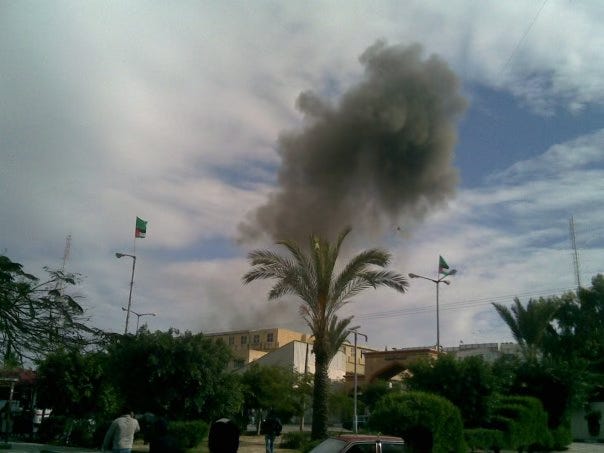
But this wasn’t the only bombing. Explosions and their aftermath filled the sky in every direction. Cellular service was down; I couldn’t reach my family. My two siblings were at different schools.
The moment I reached Omar al-Mukhtar Street, Israel bombed the al-Abbas police station. I wasn’t far from the site and felt the explosion ripple through every cell and vein in my body. This moment was captured in the documentary Tears of Gaza.
Eventually, I made it home and reunited with my family. We lived in an 11th-floor apartment in the heart of Gaza City, which gave us an unfiltered view of Israel’s brutal bombardment. We had no shelters. Instead, we kept our windows open to prevent them from shattering under the pressure of the blasts.
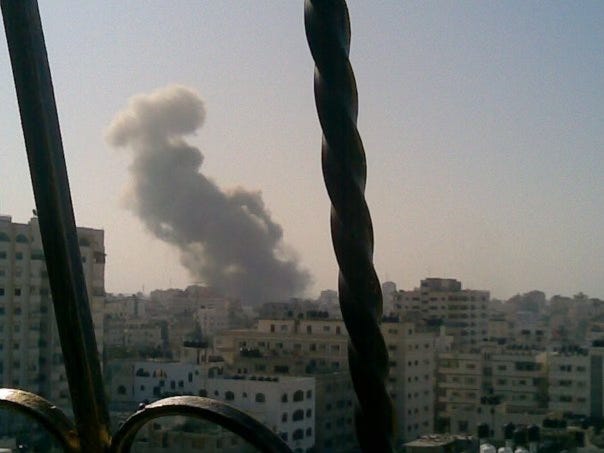
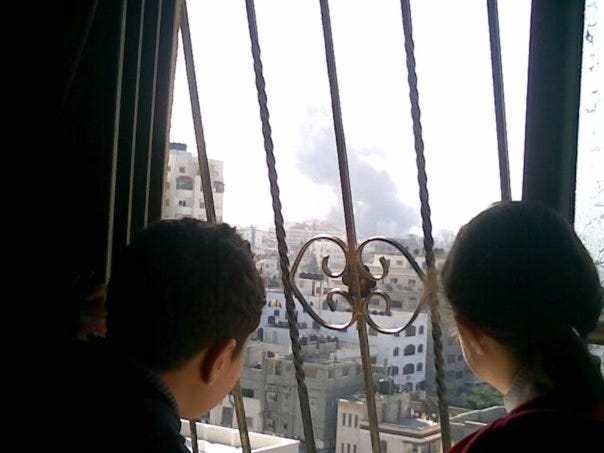
The safest place in our home was the bathroom, where we kept my younger siblings. As the cold wind howled through the apartment, so did the sounds of nearby explosions and the acrid smell of destruction. My siblings cried, shook, vomited, and panicked. I had no idea how to comfort them.
During brief ceasefires, my brother and I ventured out to get groceries and medicine. A few days into the attack, the sheer scale of destruction became visible. This was al-Shifa Mosque, located across the street from Gaza’s main al-Shifa Hospital.
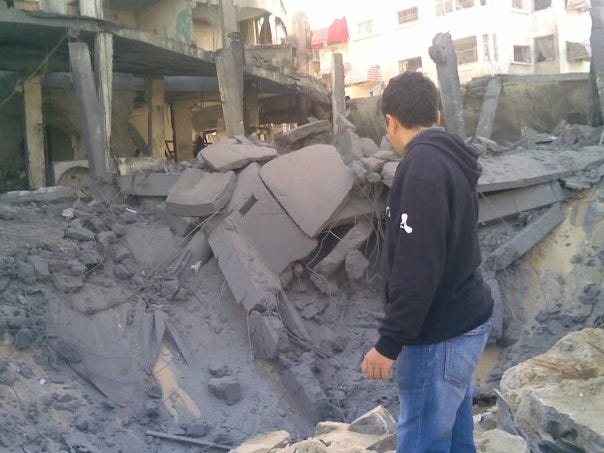
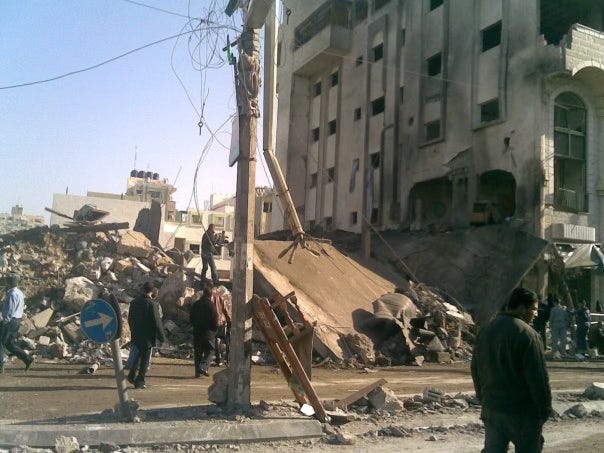
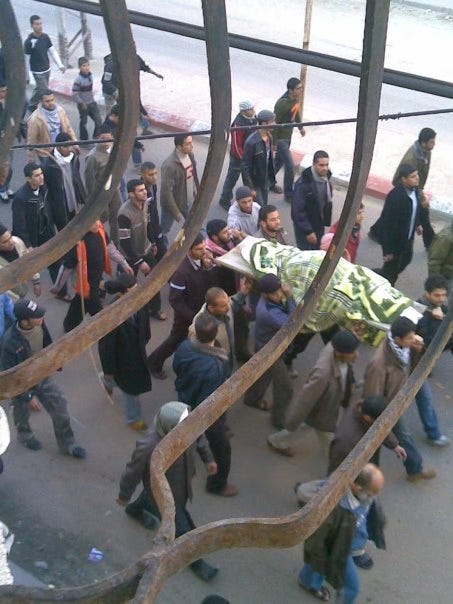
Days into the war, and with a ground invasion looming, my parents decided to leave Gaza City and return to our hometown of Deir el-Balah to stay with my grandmother. One of the darkest and most heart-wrenching memories from that time was when a nearby mosque announced that the body of an unidentified (unknown) martyr had been found along the sea road. He had no papers, no belongings—nothing that could reveal his identity or where he was from.
The mosque called on people to attend his funeral, as he had no family to mourn him. Despite the relentless bombardment, people came. I stood by the window and captured the moment this “unknown martyr” was carried past. His story—dying “unknown,” buried nameless—still haunts me to this day.
Those were horrific days, and what I’ve described here barely captures the anguish of the first days of the assault. The “Cast Lead” massacre ended on January 18, 2009, leaving 1,400 Palestinians dead, including 300 children. While the ongoing genocide eclipses “Cast Lead” in its scale and devastation, that war remains a pivotal chapter in the history that has led us to the horrific moment we’re witnessing today.
The 2008 attack on Gaza marked the beginning of large-scale and intense bombardment campaigns against the Gaza Strip. It was the precedent for the 2012, 2014, and 2021 aggressions. To grasp the scale of 2008, watch this documentary:
Israel’s Use of White Phosphorus
During “Cast Lead,” Israel indiscriminately used white phosphorus in Gaza's densely populated areas:
It is unfathomable. U.S. news barely reports & always only sharing one side. U.S. college students across our nation have been protesting to stop this war. By news media, the protesters are scorned as ignorant & Jew hating, even when many of the students protesting are Jewish, themselves. Our tax dollars are taken to continue wars that we do not want & have no say. It is a travesty & you & others who share the atrocities are brave to do so.