
"It Is Neither Death, Nor Suicide"
Gaza’s Declaration of Life—and Living

The following is an excerpt from a feature I wrote for In These Times magazine, published yesterday (March 26, 2025).
When Israel was established in the Nakba of 1948, it was built on top of 78% of historic Palestine, destroying more than 500 Palestinian towns and villages and forcefully displacing more than 750,000 people.
But one small strip of land remained beyond the Israeli conquest.
It was just a fraction of what had been taken by Zionist militias, but this small territory of 140 square miles — the Gaza Strip — would emerge not only as a site of resistance to Zionism, but as a force that would challenge colonialism, imperialism and apartheid both globally and locally.
It is, as Palestinian storyteller Mahmoud Darwish would write in the poem “Silence for Gaza,” translated from the Arabic by Sinan Antoon, equal to “the history of an entire homeland, because it is more ugly, impoverished, miserable and vicious in the eyes of enemies.”
“Because it is the most capable, among us,” Darwish wrote, “of disturbing the enemy’s mood and his comfort.”
Of the total number of Palestinians displaced in 1948 by Zionist militias — which carried out massacres and atrocities across historic Palestine — 250,000 were forced from their homes into what would later become the Gaza Strip. This changed the demographics and social structure as the displaced Palestinians joined existing residents.
The borders of the Gaza Strip, originally drawn as cease-fire lines following the Arab-Israeli War of 1948, were not considered official borders, even by the warring parties. What those demarcations did was sever Gaza from the rest of Palestine and cause unprecedented fragmentation geographically, economically, socially and culturally.
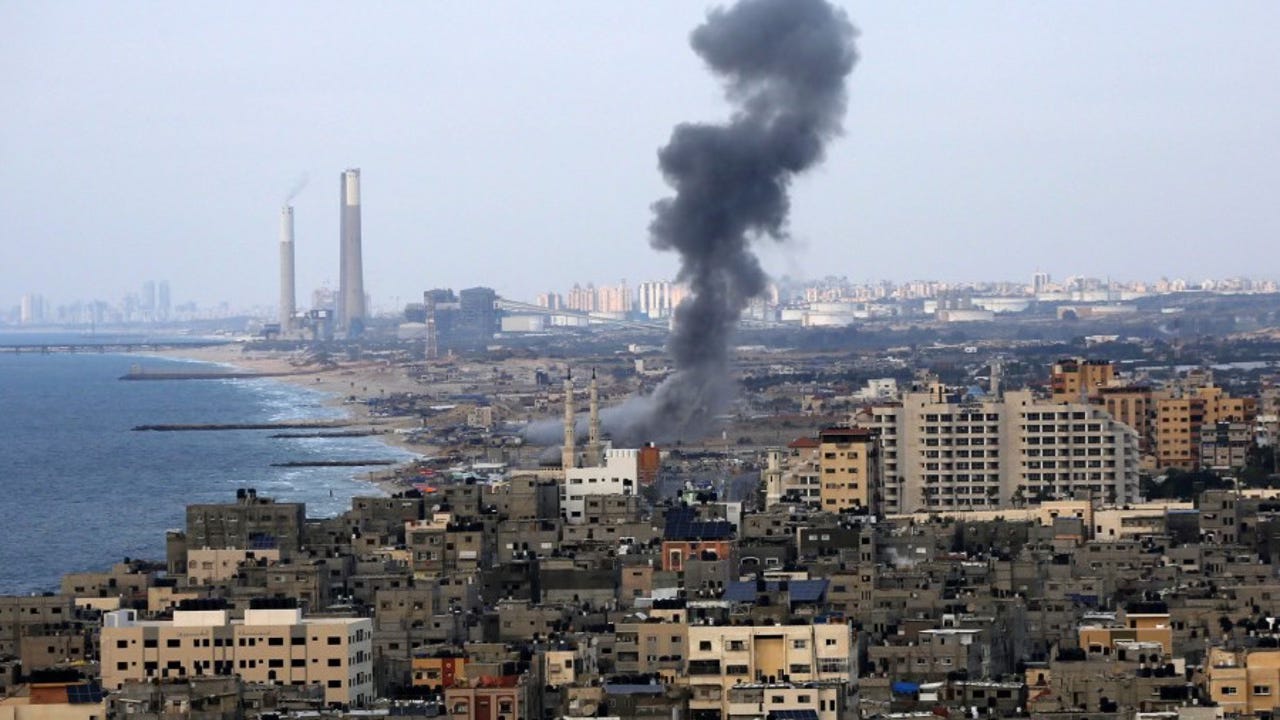
In 1955, Palestinian author Khalil Totah published the findings of his visit to Gaza to document the devastating economic collapse the city faced. Once a thriving agricultural hub, Gaza’s wheat and barley fields, which stretched to Beersheba, were gone, along with its orange groves in villages like Dayr Sunayd and Hiribya. The olive orchards, fruit and vegetable gardens and all other sources of sustenance had been stripped away.
Once a bustling marketplace which connected villages and nomads, Gaza lost its vital trade. Its streets, once filled with commerce, left the city an economic void. Describing the depth of the suffering, Totah wrote: “The inhabitants of Gaza seemed to be in a concentration camp or perhaps in a tomb. The atmosphere was most depressing, yet the people are bravely carrying on. It is a siege, indeed, and life is on a day-to-day basis.”
It is impossible to see the Gaza Strip as anything but Israel’s creation, driven by a violent, organized campaign of geographic and demographic reengineering. This dynamic continues today: Israel as the colonizer, violently clashing with Palestinians as the colonized, forming the central drive and argument at the heart of this continuation of the 76-year-old Nakba.
At its core, the Palestinian struggle today is not only about defending the rights of the Palestinian people; it has a universal dimension and deep global implications, all of which are playing out in the Gaza Strip.
Palestine has become a crucial battleground in the confrontation against the marriage of traditional colonial visions — like those that shaped the history of the United States and allowed the Israeli settler-colonial model to metastasize in its most extreme form — and the 21st-century agenda of political exclusion that strips human and civil rights from large, disadvantaged groups.
This colonial approach fundamentally relies on dehumanization to justify the extermination, the isolation, or the complete or partial denial of the fundamental human rights of the colonized.