
Israel's War on Hospitals

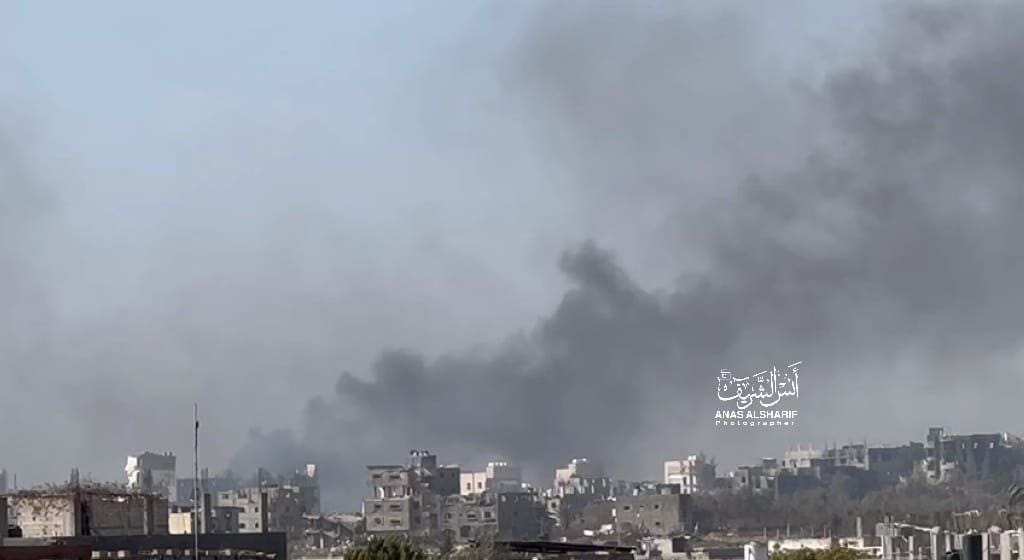
Many people continue to be shocked and puzzled each time Israeli forces “conquer” another hospital in the Gaza Strip. As I write these words, flames engulf the Kamal Adwan Hospital in Beit Lahia, in northern Gaza. This hospital offered a range of medical services, including emergency care, surgical procedures, maternity and neonatal care, and general inpatient and outpatient services. In December 2024, it was serving approximately 400 patients, including those in the neonatal intensive care unit.
But none of this seems to matter to Israel and its supporters. Israeli forces set fire to the operating rooms, surgery department, laboratory, maintenance sections, and ambulance units at Kamal Adwan Hospital. The flames are now spreading to all the hospital buildings.
Israeli forces also forced doctors and patients to walk on foot to the southern part of the region. At this point, it remains unclear how many among the medical staff, first responders, patients, or those seeking shelter at the hospital have been killed, kidnapped, or displaced.
According to Al-Jazeera correspondent Anas Al-Sharif, the fate of more than 300 people—including doctors, nurses, and patients—remains unknown following the storming of the hospital by Israeli forces and the complete loss of communication with the medical teams inside.
Here we are, another day, another hospital. Many around the world refuse to believe that such atrocities can happen in today’s world. Many refuse to believe that armies are capable of such cruelty and such blatant disregard for the sanctity of human life.
This disbelief becomes even more profound when it involves hospitals. Hospitals are supposed to be sacred institutions, protected during wartime. Under international humanitarian law (IHL), particularly the Geneva Conventions, medical facilities are granted special protections to ensure the care of the wounded and sick without interference. Specifically, the First Geneva Convention mandates that medical units, including hospitals, “shall not be attacked” and must be “respected and protected at all times.”
Yet international laws aside—though they matter—respect for the sanctity of hospitals must be an intuitive principle, not one open to debate. A hospital is a sacred entity because it serves the most vulnerable among us: NICU babies, patients, the elderly, the injured, those with disabilities, and more. In Gaza, where shelters are absent and Israeli respect for civilian sanctuaries is lacking, civilians sought safety in hospitals and hospital yards, mistakenly believing they would be safe. They were wrong.
From November 14, 2023 on X: “This footage, during which doctors and refugees transferred NICU babies, some injured, from one part of Al-Shifa to another to save their lives, while the army of a nuclear power, supported by Western powers, attacks a hospital, shows the true face of Zionism, Israel, and their supporters. Nothing can remove this shame, nothing.”
Israel’s war on Gaza, as I have previously discussed, aims to destroy the foundations of society in the Gaza Strip. This is not speculation or a baseless claim. For months, Israeli generals and academics have advocated for an “extermination” campaign in northern Gaza. For details on how these ideas evolved, click here.
When a regime is engaged in a war of extermination, aimed at liquidating entire communities and displacing them to settle their lands, it should not be surprising that even hospitals are not spared in this genocidal campaign.
In the minds of Israel’s leaders, the annihilation and extermination of Palestinian communities in Gaza is a necessary step to restore confidence in Israel’s colonial project and its ability to fortify itself against its victims. Thus, the actual goals of Israel’s campaign in Gaza extend beyond the declared objectives of eradicating Hamas, releasing hostages, neutralizing threats, and facilitating the return of Israeli residents to the “Gaza cover” area.
Israel seeks to subjugate Gaza—not just as a place, society, or people, but also as an idea: an incubator for resistance and defiance that has haunted Israel since its establishment in 1948. According to Israel’s settler-colonial logic, Gaza, a geographic entity created by the Zionist conquest of Palestine, is where hundreds of thousands of Palestinians were condemned to remain as impoverished refugees. These people were expected to dwell in silence for eternity, never raising their voices or asking when their misery would end.
But silence was never an option for Palestinians in Gaza. They made sure to remind Israel of their existence and their just demands. In response, Israel employed strategies ranging from massacres and settlement building to blockades, mass incarceration, and seasonal “mowing the lawn” bombardment campaigns. Now, it has escalated to a genocide aimed at “finally” ending the Gaza “question.”
October 7 marked the realization for Israel that its only solution for Gaza must be a final one. However, these schemes were not improvised in the wake of the October 7 attacks—they had been discussed and prepared long before, awaiting the “right” moment for implementation. Debates over Gaza’s future from an Israeli perspective—including notions of expulsion, displacement, re-occupation, and annexation—have long been public and explicit. See, for example, this report, which I translated from Hebrew. Originally aired by Israeli Channel 11 to mark the 15th anniversary of Israel’s redeployment from within Gaza, it features interviews with Israeli political, military, and intelligence figures discussing Israel’s approach to Gaza.
In this context, the destruction of hospitals as sanctuaries for life becomes a calculated statement: life, as it was known, has come to a halt, if not ended entirely. Sparing hospitals could signal that life might one day be restored. By targeting these institutions, Israel conveys that no such restoration is forthcoming.
In Gaza, where sovereign institutions are absent due to the lack of Palestinian statehood, hospitals become symbols of sovereignty in times of war and crisis. They serve as places of gathering, information sharing, and speaking to the world through press conferences and protests.
This was the case with Al-Shifa Hospital in Gaza City, a sprawling complex offering critical services to Palestinians under blockade. Beyond its medical role, Al-Shifa served as a gathering place for citizens and journalists, a venue for press conferences, and a sanctuary for the injured and displaced.
By seizing and ravaging Al-Shifa, Israel signaled the end of life in Gaza City as Palestinians have known it for decades (even though Palestinians in Gaza rebuilt parts of Al-Shifa later on). Removing this hospital from Gaza’s healthcare infrastructure also aimed at obscuring the scale of casualties and injuries among the hundreds of thousands who remain north of Wadi Ghazza.
In the absence of state institutions, the destruction of hospitals, mosques, and universities serves as a symbolic defeat of the Palestinian people. For Israel, the fall of Al-Shifa carries historical significance, as it mirrors past events like the 1967 occupation of Gaza. In 1967, following Gaza’s occupation by Israeli forces, Egypt’s then military governor of Gaza, Major General Abdel Mon’em al-Hassani, surrendered to Israeli forces at Al-Shifa.
Despite the scale, brutality, and intensity of Israel’s current strategy in Gaza, it follows a familiar counter-insurgency principle: targeting civilian “incubators” of resistance to break its backbone. While such measures may yield short-term results, they fail in the long term because the conditions that give rise to resistance remain unaddressed, perpetuating an endless cycle of violence and a recurring cycle of clash between the colonizer and the colonized.