Deir el-Balah’s Stolen Past: A Canaanite City Looted Under Occupation

Did you know that in the 1970s and 1980s Israel looted one of the most important Canaanite sites in Gaza, a site closely tied to ancient Egypt? This is the story of how Israeli archaeologists and the military removed historical treasures from my hometown, Deir el-Balah.
A “chance” discovery under occupation
In 1982, National Geographic reported the uncovering of a Canaanite settlement, fortress, and cemetery west of Deir el-Balah, in the middle of the Gaza Strip. The site, more than three thousand years old, was identified by Israeli archaeologist Trude Dothan.
The find began after Israel’s 1967 occupation. Dothan saw a coffin lid in a Jerusalem souvenir shop, traced it to Gaza’s sands, and after months of searching found its source on a farm in Deir el-Balah. Excavations followed. To conduct them, Dothan relied on Defense Minister Moshe Dayan, who provided logistical and security support to the archaeologists. The excavation paused in the late 1960s and early 1970s when Gaza waged an armed insurgency against the Israeli occupation. Archaeological excavations advanced later on under the protection of an occupying army.


What the excavations revealed
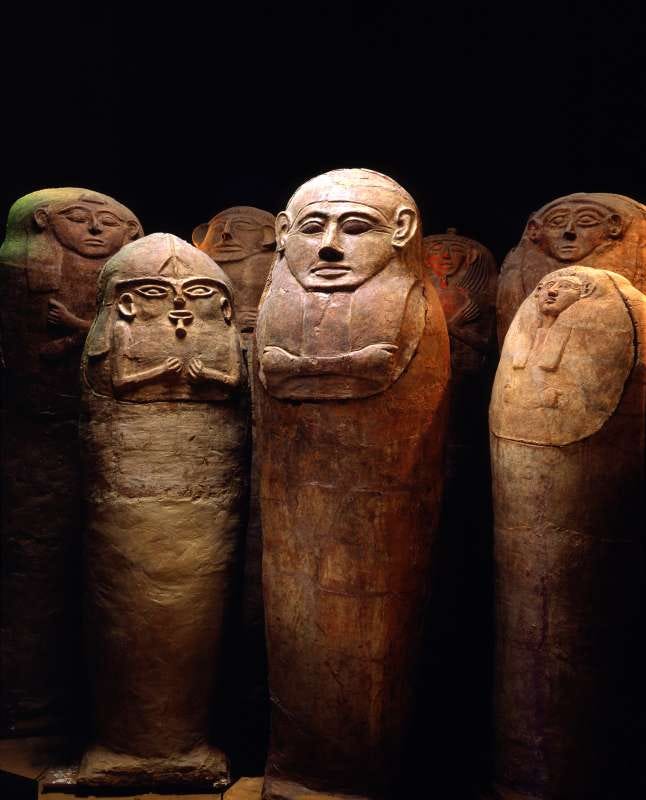
As Dothan’s team dug the cemetery over nearly a decade, the scale of the discovery exceeded expectations. They uncovered tombs, artifacts, and anthropoid clay coffins in several styles and forms. The Bronze Age material offers a vivid account of life along the Palestinian coast, including spiritual beliefs, burial practices, and even culinary habits.
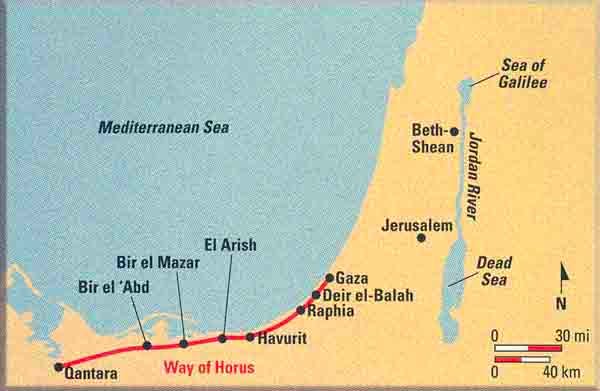
Crucially, the site illuminates the complex ties between the Egyptian Empire and local Canaanites. The evidence suggests a blending of cultures and likely the presence of Egyptian officials or soldiers securing the ancient “Way of Horus,” the strategic coastal road of New Kingdom Egypt.
The team also unearthed a palace about 55 meters long with 15 rooms and thick outer walls, along with a clay seal bearing hieroglyphic inscriptions comparable to those at Tell el-Amarna, supporting a 14th-century BCE date. A fortress came to light as well. Dothan argued that its plan closely resembles fortresses carved on the walls of Karnak, especially those documenting Seti I’s campaign in Canaan. Semi-final conclusions tied the fortress to a period of strong Egypt–Canaan relations, with estimates placing it in the reign of Seti I, given as roughly 1318 to 1304 BCE.


Who lived in Deir el-Balah 3,300 years ago
A leading theory holds that the population was a mix of local Canaanites and Egyptians who coexisted along the Way of Horus, with garrisons and administrators maintaining imperial security while daily life unfolded around them. It was a frontier community shaped by empire and locality at once.
From layered history to biblical proof-text
Rather than present this layered, regional history on its own terms, Dothan and others focused on using Deir el-Balah to “prove” a biblical storyline. They argued that a fortress along the Way of Horus could explain why the Children of Israel avoided the coastal road and took a longer desert route to Canaan, aligning the archaeology with a specific reading of Exodus.
According to this view, the Israelites deliberately bypassed the coastal route to evade Egyptian garrisons. The obsession with proving Exodus reflects a commitment to a Zionist narrative that elevates Old Testament validation over the full archaeological record. It has overshadowed the broader historical significance of Deir el-Balah as a Canaanite–Egyptian crossroads.
Looted past, museum glass
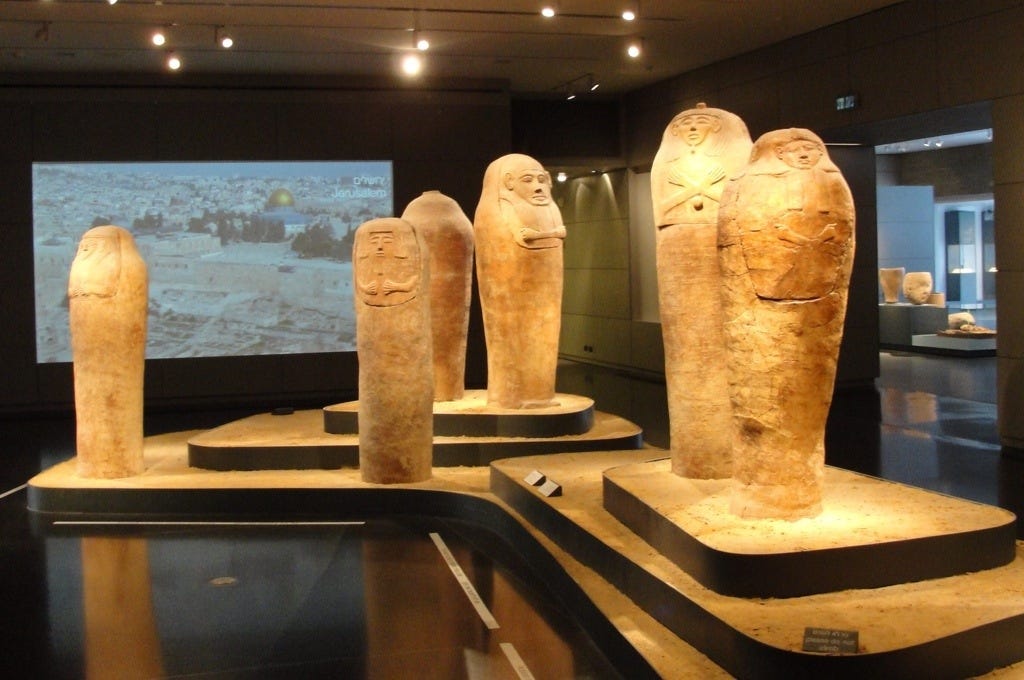
The anthropoid coffins and other finds are now displayed at the Israel Museum in Jerusalem. The site in Deir el-Balah was emptied of what could be carried. The full fate of the site remains unclear and demands answers from Israeli archaeologists and the military who removed the material. Some artifacts have also been claimed or purchased by wealthy Americans. Provenance, inventories, and export trails should be transparent. These are basic standards of ethical archaeology and cultural heritage.
War and heritage at risk
As Israel’s genocidal war continues to ravage Gaza, the status of the site in Deir el-Balah is unknown. No one can say whether it survives, especially after Israel has destroyed more than 200 heritage sites across Gaza with no regard for their value. The pattern is clear: the past is extracted and re-narrated elsewhere, the present is bombed, and the future is placed out of reach.
A constructive demand: Cairo’s Grand Egyptian Museum
There is an opening for action. Egypt just opened the Grand Egyptian Museum and has begun demanding the return of stolen artifacts. As a Palestinian historian from Deir el-Balah, I want to see this energy extended to Gaza. The Egyptian government, in coordination with Palestinian authorities and archaeologists, should demand that Israel return the artifacts looted from Deir el-Balah.
As an interim step, Egypt could house the Deir el-Balah artifacts at the Grand Egyptian Museum under a joint Egyptian–Palestinian stewardship until Gaza has the capacity to conserve and display them. The exhibit should present Deir el-Balah as it truly was: a Canaanite–Egyptian frontier of exchange, administration, and daily life. It should not be used to prop up biblical narratives that archaeology cannot prove.
This is not only about objects. It is about honoring a real, complex past and the people to whom it belongs. Deir el-Balah’s story is part of a longer pattern in which archaeology under occupation extracts value from Palestinian land, relocates it behind museum glass, and interprets it through political needs rather than historical truth.
Gaza carries thousands of years of human experience, not only the last years of grief. Returning the looted past is part of insisting on life, dignity, and memory against erasure. History is not a trophy to be claimed and collected. It is a trust to be returned.